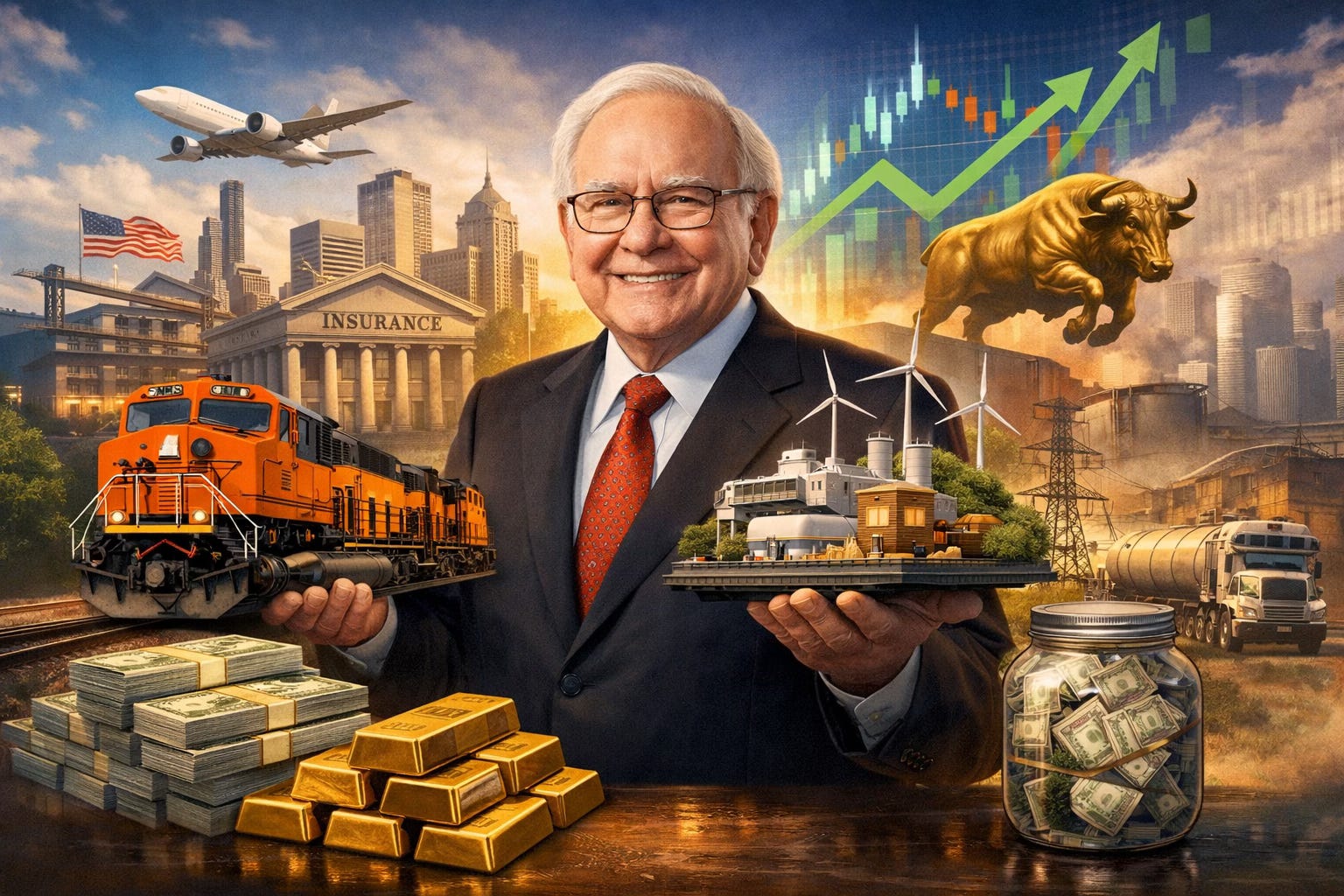
Inside Berkshire Hathaway’s Compounding Engine
One of the most durable wealth-building machines in modern capitalism

There is a number I keep coming back to when I think about Berkshire Hathaway: $760 billion.
That is the approximate cumulative earnings Berkshire has retained over its lifetime, rather than paying out as dividends. No company in history has ever done anything like it. It is not simply an investment strategy. It is the most serious, sustained, and successful demonstration of what happens when exceptional capital allocation meets a permanent time horizon.
I spent thirty years inside traditional finance, as a CPA, a capital markets executive, a bank Treasurer and CIO, and ultimately a CFO overseeing growth from $18 billion to $48 billion in assets. I have spent years studying every dimension of Berkshire Hathaway with the same analytical rigor I brought to managing billions in institutional capital. You can find my ongoing research on my personal website, including current intrinsic value estimates, analyst targets, and share repurchase data. I keep arriving at the same conclusion: Berkshire is not merely a conglomerate or a holding company. It is the closest thing in modern capitalism to a permanently capitalized industrial trust, and its structural advantages are so durable and so genuinely impossible to replicate that it belongs in a category entirely its own.
The Float: The Most Powerful Mechanism in Finance
Everything at Berkshire begins with the insurance float. Berkshire collects premiums before it pays claims. The gap between collection and payout generates a pool of capital, currently over $176 billion, that Berkshire holds and deploys as if it were its own. In most businesses, leverage like this costs something. Interest rates, credit spreads, funding risk. The cost of capital is a constant constraint.
At Berkshire, the cost of this capital is effectively zero. Not metaphorically zero, literally zero, and in most years less than zero, because the insurance operations themselves are profitable. Over the past five years, the float grew by $29 billion while generating underwriting profits. Berkshire is being paid to borrow. No other capital structure in public markets offers this combination of scale, duration, and negative cost of funding.
As someone who spent a career managing funding costs for a major financial institution, I can tell you exactly how rare this is. I spent years working to lower cost of funds by basis points. Berkshire’s structural advantage here is not measured in basis points. It is categorical. No one else has this model at this scale, and no one can build it quickly. It took fifty years of disciplined compounding to construct, and its moat deepens with every year it continues.
That float is then deployed with extraordinary discipline by centralized capital allocation at headquarters, into irreplaceable infrastructure assets that span the full breadth of the American economy. No other publicly traded entity owns outright the largest North American railroad, one of the nation’s largest utility systems, a dominant global reinsurance franchise, and dozens of leading manufacturing and consumer brands, all while sitting on $373 billion in liquid capital.
The Railroad: Critical Infrastructure You Cannot Replicate
BNSF Railway operates approximately 32,500 route miles across 28 states and three Canadian provinces, making it the largest freight railroad in North America. This is an asset that cannot be replicated at any price.
The right-of-way, terminal infrastructure, and intermodal network represent barriers to entry that are permanent and absolute. As supply chains reconfigure to favor domestic sourcing and nearshoring from Mexico, BNSF’s transcontinental and north-south corridors are uniquely positioned to benefit. The railroad also captures secular growth in intermodal shipping, grain and agricultural exports, and industrial products transportation. Operating improvements have driven the operating ratio to 65.5%, with further improvement potential as precision scheduled railroading initiatives mature.
This is not a business that faces disruption. It faces physical reality. You cannot build a competing railroad. The land does not exist, the right-of-way cannot be acquired, and the economics make it structurally impossible. BNSF is a permanent barrier to entry masquerading as a transportation company.
An Energy Powerhouse for an Energy-Hungry Economy
Berkshire Hathaway Energy is among the largest utility operators in the United States, serving customers across Iowa, Utah, Wyoming, Oregon, and beyond through PacifiCorp, MidAmerican Energy, and NV Energy. At a moment when electricity demand is surging, driven by data center buildouts for artificial intelligence, electric vehicle adoption, and the electrification of industrial processes, BHE’s regulated utility base represents a secular growth asset that the market continues to undervalue.
MidAmerican Energy has already achieved near-100% renewable energy generation in Iowa, positioning it as a preferred utility partner for hyperscale data center operators seeking clean power. The combination of regulated returns, long-duration infrastructure assets, and exposure to the AI-driven demand supercycle makes BHE a far more valuable franchise than its current earnings alone suggest.
This is not a bet on energy transition. The transition is already happening, and BHE is already there, already built, already operating at scale.
Domestic Manufacturing in an Onshoring World
Berkshire’s manufacturing footprint is positioned to benefit from the most significant reshoring trend in a generation. Precision Castparts produces mission-critical aerospace components, castings, and forgings essential to both commercial aviation and defense supply chains. Lubrizol is a global leader in specialty chemicals. Alongside dozens of other subsidiaries including Marmon, Brooks Sports, and Fruit of the Loom, Berkshire represents deep domestic manufacturing capacity at a time when policymakers on both sides of the aisle are prioritizing supply chain resilience and American industrial self-sufficiency.
The bipartisan push toward onshoring, reinforced by tariff policies and federal incentive programs, creates a multi-year tailwind for Berkshire’s $77 billion manufacturing revenue base. Unlike companies scrambling to build domestic capacity, Berkshire already has it. This is the kind of structural advantage that is invisible in a good environment and becomes invaluable in a stressed one.
$373 Billion in Dry Powder: Optionality Without Precedent
Perhaps Berkshire’s most powerful competitive advantage today is one that is frequently criticized: its massive cash position.
With $373 billion in cash and short-term Treasury investments, Berkshire possesses a war chest that exceeds the market capitalization of all but a handful of S&P 500 companies. This capital can be deployed in a single phone call, without the need for syndicated financing, shareholder votes, or regulatory approval that constrains every other acquirer. In a credit-tightening environment, Berkshire’s ability to write a check for $50 to $100 billion or more for a transformative acquisition is an unmatched strategic advantage.
History is instructive. Berkshire’s best acquisitions, from Burlington Northern to Precision Castparts, have come during periods of market dislocation. When everyone else is cash-starved and desperate to sell, Berkshire is the buyer of last resort. Greg Abel has indicated the company is actively evaluating opportunities, and the resumption of buybacks in March 2026 signals that Berkshire’s own leadership views the current valuation as attractive.
The Buyback Discipline Tells the Story
Berkshire changed its repurchase philosophy only three times in nearly sixty years: in 2011 at 110% of book value, in 2012 at 120% of book value, and in 2018 to repurchase below intrinsic value as conservatively determined. These changes are never made without deep, intentional consideration.
Since the 2018 authorization, Berkshire repurchased shares aggressively through 2024, retiring over 13% of shares outstanding while still growing its cash reserves to record levels exceeding $370 billion at year-end 2025. Those repurchases have compounded enormous value for remaining shareholders.
Notably, 2025 was the first full calendar year with zero buybacks since the 2018 program change. This was a deliberate signal from both Buffett and incoming CEO Greg Abel that the stock was not trading at a sufficient discount to intrinsic value to warrant repurchases. Abel resumed buybacks in March 2026, signaling the opposite. When Berkshire buys its own stock, it is worth paying attention.
What Is Berkshire Actually Worth?
I maintain current intrinsic value and target price estimates from analysts and institutional investors who have spent the most time building detailed models of Berkshire’s components.
Christopher Bloomstran of Semper Augustus, who publishes an annual analysis of approximately 60 pages, calculated 2025 intrinsic value at approximately $1.23 trillion, or $855,396 per Class A share. He projects the stock can compound at 10 to 12% annually over the next decade, driven by disciplined deployment of Berkshire’s enormous cash position under Abel’s leadership. Whitney Tilson of Stansberry Research estimates intrinsic value at approximately $801,000 per A share. UBS has the most bullish analyst price target at $866,429 per A share.
With shares recently trading around $745,000, Berkshire is available at a 10 to 14% discount to conservative intrinsic value estimates. For a business of this quality, that is a meaningful margin of safety, and precisely the kind of opportunity that Buffett has always required before deploying capital.
The post-Buffett concern is real but, I believe, overstated. Berkshire was designed specifically to outlast any single individual, including its founder. The culture, the structure, the incentive systems, the decentralized operating model: all of it was engineered to function without the genius at the top. Abel inherits a machine, not a dependency.
The Culture That Makes It Permanent
What Berkshire has built is not just a portfolio of assets. It is a culture that took fifty years to engineer and that actively filters for the right kind of owner.
The refusal to split Class A shares is a signal. It tells you what kind of investor Berkshire wants. Also, zero dividends in over fifty years (all earnings retained and reinvested) is the most sustained demonstration of compounding discipline in corporate history.
The operating model extends this philosophy throughout the business. Berkshire’s headquarters employs approximately 25 to 30 people. Subsidiaries run themselves, with no centralized HR, no forced synergies, no bureaucratic overhead. Managers operate their businesses as if they are the only asset their family will own for the next hundred years. The mandate is to guard reputation above all else.
This is not a management style. It is a structural advantage. It eliminates the friction that destroys value in most large organizations and replaces it with something that almost no corporate structure can replicate: genuine, durable, owner-operator alignment at every level.
Why Now
Berkshire crossed a $1 trillion market cap in August 2024. The instinct for some investors is to assume that means it is fully valued, that the opportunity has passed. The intrinsic value analysis says otherwise.
A business trading at a 10 to 14% discount to conservative fair value, with accelerating operating earnings since 2018, a $373 billion war chest that can be deployed by a disciplined new CEO, and a structural compounding engine that has no peer in the public markets. This is not a business where the opportunity has passed. This is a business where the patience required to own it has simply filtered out the investors who should not own it in the first place.
No company has ever retained $760 billion in earnings and compounded it the way Berkshire has. No company has built an insurance float of this scale and cost structure. No company has assembled this collection of irreplaceable infrastructure assets under a culture of this durability. Berkshire is genuinely singular, and singular businesses at reasonable discounts to intrinsic value are among the rarest things in investing.