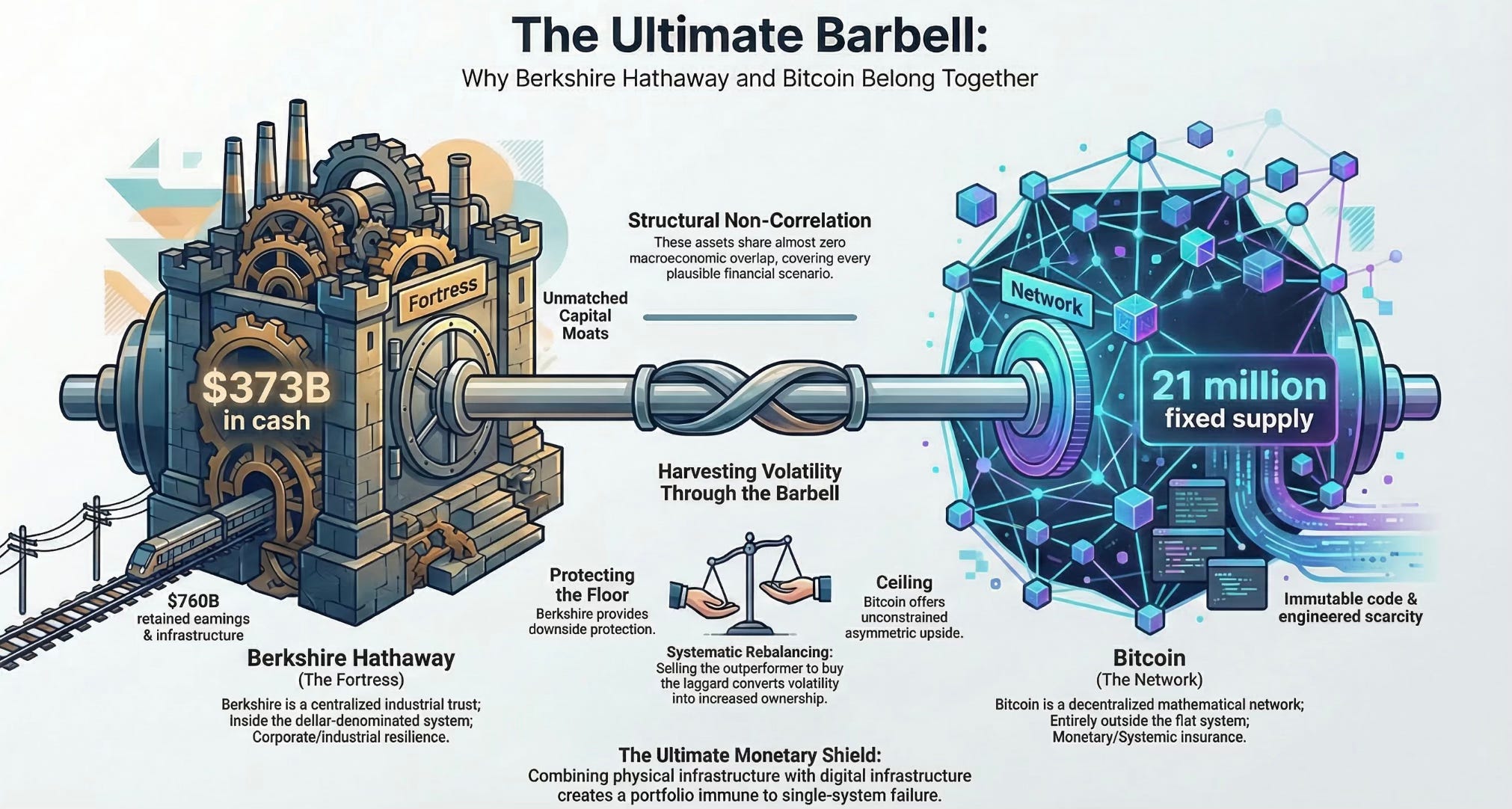
The Ultimate Barbell
Why Berkshire Hathaway and Bitcoin may be the most powerful portfolio combination in modern markets

If you have read my pieces on Berkshire Hathaway and Bitcoin separately, you already understand why I believe each one deserves a permanent place in a long-term portfolio. But this article is about something more specific: why these two assets work better together than anything else I have found in thirty years of studying capital markets.
The answer has to do with a principle that does not get enough attention: structural non-correlation. And with a strategy built on that principle, one I believe represents the most complete approach to long-term wealth preservation I have ever encountered.
The Problem With Every Other Portfolio
Traditional portfolio construction is built on a faulty assumption that diversification between stocks and bonds is sufficient to protect purchasing power over time.
It was a reasonable assumption for much of the twentieth century. But the world has changed. We are in an era of persistent fiscal deficits, structural monetary expansion, and currency competition between major economies. The 60/40 portfolio, built for moderate inflation, positive real yields, and monetary stability, is fundamentally challenged by this environment. When the response to every crisis involves more money creation, owning only dollar-denominated assets is an incomplete strategy.
What most portfolios lack is not diversification across asset classes. It is diversification across monetary systems. Berkshire lives inside the dollar-denominated financial system. Bitcoin lives entirely outside it. That difference is not incidental. It is the foundation of the entire strategy.
A Study in Uncorrelated Opposites
Berkshire Hathaway is a centralized holding company, generating cash flows from essential businesses, holding over $373 billion in fiat dry powder, tied directly to American industrial health. Its value is denominated in dollars, its performance correlates with the health of the domestic economy, and its fortress balance sheet makes it one of the most resilient businesses ever constructed. As I detail in my Berkshire research, it owns the largest freight railroad in North America, one of the nation’s largest utility systems, and a $77 billion domestic manufacturing base, all underpinned by a $176 billion insurance float that carries a negative cost of funding.
Bitcoin is a decentralized global network, generating no cash flows, with a fixed supply of 21 million coins, completely independent of any single nation’s economy. Its value is governed by mathematics rather than management, its performance is driven by monetary scarcity and global adoption, and it carries no counterparty risk of any kind. As I explain in my piece on My Reluctant Path to Bitcoin, it took me hundreds of hours of serious study to arrive at this view and the full case is in 100 Reasons Bitcoin May Be the Most Important Asset of Our Lifetime.
These two assets share almost zero structural or macroeconomic overlap. They are not just different. They are opposite. And that is precisely the point. Two fundamentally sound, trillion-dollar assets that move independently of each other create something that a portfolio of correlated assets cannot: genuine optionality across every macro scenario.
The Mechanics of Volatility Harvesting
Here is where the strategy becomes genuinely interesting. Most investors treat Bitcoin’s volatility as a liability. Something to be minimized, hedged, or avoided. The barbell portfolio treats it as the opposite: as kinetic energy that can be harvested and converted into compounding ownership of both assets.
The mechanics are simple. Maintain a disciplined target allocation between Berkshire and Bitcoin. The specific ratio depends on your risk tolerance, but the key is that it is predefined. Then rebalance systematically when they diverge, which they will do frequently and dramatically.
When Bitcoin rallies sharply and Berkshire lags, trim Bitcoin and rotate into Berkshire. You are selling the outperformer at elevated prices and buying the world’s greatest business at a relative discount. When Berkshire outperforms and Bitcoin pulls back, which also happens regularly, trim Berkshire and accumulate more Bitcoin at lower prices. The 2025 rebalancing event illustrated this precisely: Berkshire appreciated roughly 20% year-to-date while Bitcoin declined by a similar margin in March, creating a clear signal to rotate. Then in July, the dynamics flipped. Bitcoin recovered sharply while Berkshire modestly retraced, creating the opposite trade.
Over time, this mechanical rotation converts divergence into accumulation. You end each cycle holding more underlying shares and more bitcoin than you started with, funded entirely by harvested volatility rather than new capital. The portfolio compounds without requiring external funding. The more volatile Bitcoin becomes, the more opportunities there are to harvest.
This is not market timing. It is the opposite of market timing. There is no forecasting involved, no economic prediction, no view on where either asset is going next. It is a predefined rule set that relies entirely on observable divergence and mathematical reversion. Emotion is removed from the equation by design.
What Each Side Covers
The Fortress, Berkshire provides downside protection. Its massive insurance float, consistent cash generation, and $373 billion war chest protect capital during severe economic contractions. When markets panic, Berkshire thrives. It buys distressed assets at panic prices and emerges from every crisis larger and stronger than it entered. It is the floor.
The Network, Bitcoin provides unconstrained upside. A history of delivering outsized, asymmetric gains. Complete independence from the monetary system that all other assets depend on. A global adoption curve that is still in its early majority phase, with institutions, corporations, and nation-states continuing to accumulate. I track this adoption story daily in Why Bitcoin Will Win.
Together, they create a risk-reward profile that no traditional portfolio can replicate. Strategic allocations to Bitcoin, even modest ones of 1 to 5%, dramatically boost risk-adjusted returns without breaking the portfolio’s structural drawdown limits. This is not speculation. It is engineering.
The Scenario Analysis
Walk through various plausible macro scenarios and ask which of these two assets benefits.
The economy grows, corporate earnings expand, American industry thrives. Berkshire wins. The industrial assets appreciate, the operating earnings compound, and the war chest finds productive deployment. BNSF benefits from reshoring supply chains. BHE captures data center electricity demand. The manufacturing base rides the onshoring tailwind.
Monetary policy remains reckless. Deficits expand. Currency purchasing power erodes. Bitcoin wins. As the only fixed-supply monetary asset in the world, it benefits directly from every dollar of new money creation that dilutes existing holders.
A genuine systemic crisis unfolds. Banking failures, sovereign defaults, institutional instability. Both assets benefit in different ways. Berkshire becomes the buyer of last resort with its enormous cash position, acquiring generational assets at panic prices. Bitcoin functions as the lifeboat it has already proven to be in the SVB collapse, the Lebanese banking crisis, and the Turkish currency crisis.
There is no scenario in which both assets simultaneously fail. They are too different, too structurally uncorrelated, and too fundamentally sound for that outcome. That is the definition of a true hedge: not an asset that sometimes zigs when others zag, but a structural pair that covers every scenario by design.
The Mindset Required
Both of these assets require the same thing from an investor: genuine long-term conviction. Not patience in the abstract, but the real, practiced ability to ignore quarterly noise and short-term speculation.
Berkshire actively filters for this. The refusal to split Class A shares, the zero-dividend policy, the culture built around holding winners forever: all of it is designed to attract investors who think in decades and repel investors who think in quarters.
Bitcoin demands it in a different way. Its volatility punishes short-term thinking harshly and rewards long-term conviction generously. Every ten-year holding period in Bitcoin’s history has produced extraordinary returns. Every short-term trader who sold during a drawdown gave those returns to someone else.
The investor who pairs these two assets with genuine long-term conviction, who maintains the discipline to rebalance mechanically rather than emotionally, who can hold the world’s greatest compounding machine alongside the world’s most powerful monetary network and simply wait, is playing a fundamentally different game than the rest of the market.
By pairing the irreplaceable physical infrastructure of the twentieth century with the immutable digital infrastructure of the twenty-first, that investor gains a structural edge that cannot be manufactured by any amount of stock-picking, market-timing, or tactical allocation.
The Fortress protects against the market. The Network protects against the system. Together, they form the ultimate shield.
Embrace the divergence. Harvest the volatility. Compound true wealth.